


CNRRI Research Published in Science Reveals Genetic Basis for Early Maturity and High Yield in Rice
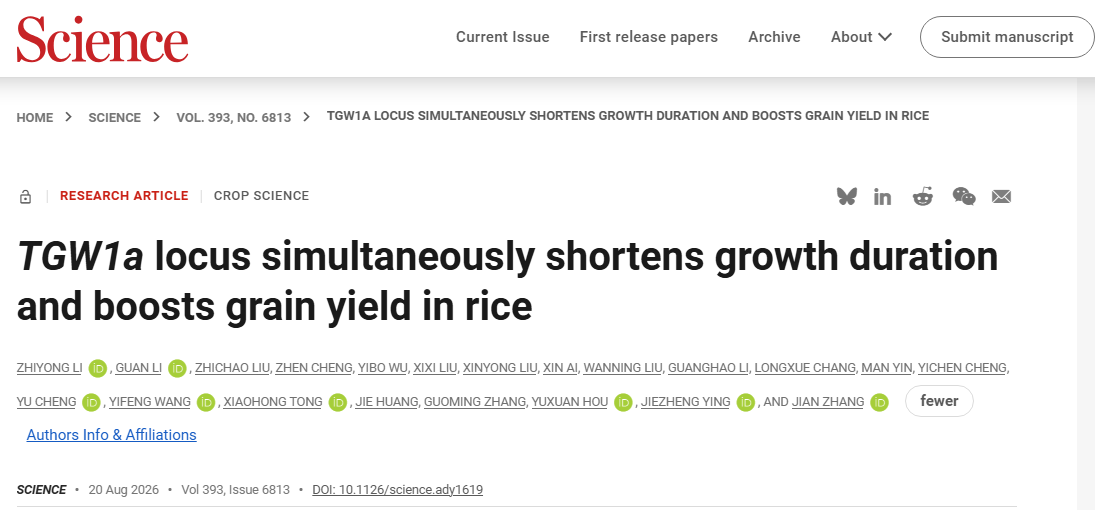
August 21, 2026, Hangzhou, China, The China National Rice Research Institute (CNRRI) announced a major scientific breakthrough by its research team led by Dr. Jian Zhang at the State Key Laboratory of Rice Biological Breeding. The team’s latest study, published in Science under the title “TGW1a locus simultaneously shortens growth duration and boosts grain yield in rice,” identifies a rare allele, TGW1aJZ, that shortens growth duration while increasing grain yield. The work revealed a complex molecular mechanism in which a florigen-like protein links the flowering clock with nitrogen use efficiency (NUE), thus overcoming the genetic trade-off between early maturity and high yield. The discovery provides a new theoretical foundation and valuable genetic material for breeding next-generation rice varieties.
Early Maturity versus High Yield: A Century-Long Breeding Challenge
Government policies have underscored the strategic importance of multi-cropping grain production in China’s southern provinces, as set forth in the No. 1 Central Document of 2023. Despite these ambitions, the widespread adoption of sustainable crop rotation systems—such as those involving rice-rice-oilseed or rice-rapeseed sequences—has been limited due to narrow crop rotation windows and high labor requirements.
Breeding rice varieties that combine short growth duration and high grain yield has long been considered a key strategy to overcoming this bottleneck. However, earlier flowering usually shortens the vegetative growth, leading to reduced biomass accumulation and yield loss. For every one-day reduction in growth duration, rice typically suffers a 0.8% to 1.2% yield penalty. This enduring challenge, the so-called "early maturity versus high yield" dilemma, has persisted for over a century and is a critical focus for crop breeders worldwide.
Florigen-like Protein Offers a Breakthrough Solution
Using the indica cultivar Huanghuazhan (HHZ) and the early-maturing, large-grain japonica accession Jizi 1560 (JZ) as parental lines, the CNRRI team constructed a recombinant inbred line (RIL) population, successfully mapping the major-effect locus qTGW1a. This locus encodes FT-L1, a florigen-like protein acting as a central flowering-inducing signal in rice. Remarkably, TGW1a enables rice to directly sense nitrogen signals and enhance nitrogen uptake and utilization. This finding identifies the florigen-like protein as a central molecular hub that simultaneously modulates three critical agronomic traits: flowering time, nitrogen-use efficiency, and grain yield.
TGW1a alleles from diverse rice germplasm fall into three categories—ancestral JZ-type, HHZ-indica type, and japonica type—each with distinct, dosage-dependent effects on gene expression. TGW1a enables shorter growth duration with elevated NUE, addressing the natural antagonism between maturity and nitrogen utilizationation. Notably, the JZ allele maintains a moderate expression level, striking an optimal balance and maximizing grain productivity.
Multi-Site Trials Demonstrate Earlier Maturity and Higher Yield
TGW1a is closely linked with the high-yield gene Gn1a. Most rice varieties carry antagonistic combinations, with favorable alleles for one trait often compromising the other. The CNRRI team demonstrated that breeders can harness TGW1a by selecting aus-type donors with the optimal "win-win" allele combination for both genes, or by breaking the genetic linkage between Gn1a and TGW1a.
The research team introduced the JZ-type TGW1a into widely grown early-indica cultivars Zhongjiazao 17 and Zhongzao 39, as well as restorer lines Huazhan and R173, using advanced molecular breeding approaches. Multi-site field trials conducted over three consecutive years in Hangzhou (Zhejiang) and Nanning (Guangxi) confirmed impressive results: improved lines demonstrated a 3 to 8-day reduction in growth duration and a 4.2% to 11.0% yield increase. Hybrid combinations derived from these lines also showed outstanding early-maturing and high-yield performance. These findings establish TGW1a as a breakthrough tool for achieving early-maturity-high-yield phenotypes in both inbred and hybrid rice, paving the way for expanded use of multi-cropping systems.
This groundbreaking research was financially sponsored by the Biological Breeding-National Science and Technology Major Project, the National Natural Science Foundation of China, and the Young Innovation Program of the Chinese Academy of Agricultural Sciences. Key contributors to the study including Drs. Zhiyong Li, Guan Li, Jiezheng Ying, and Jian Zhang.
Artical link: https://doi.org/10.1126/science.ady1619
· CNRRI Research Published in Science Reveals Genetic Basis for Early Maturity and High Yield in Rice
· CNRRI Experts Visit Indonesia to Promote Sustainable Agricultural Cooperation
· CNRRI Hosted International Seminar on Genetic Basis and Molecular Breeding of Abiotic Stress in Rice


CNRRI Today
Copyright © 2014- China National Rice Research Institute